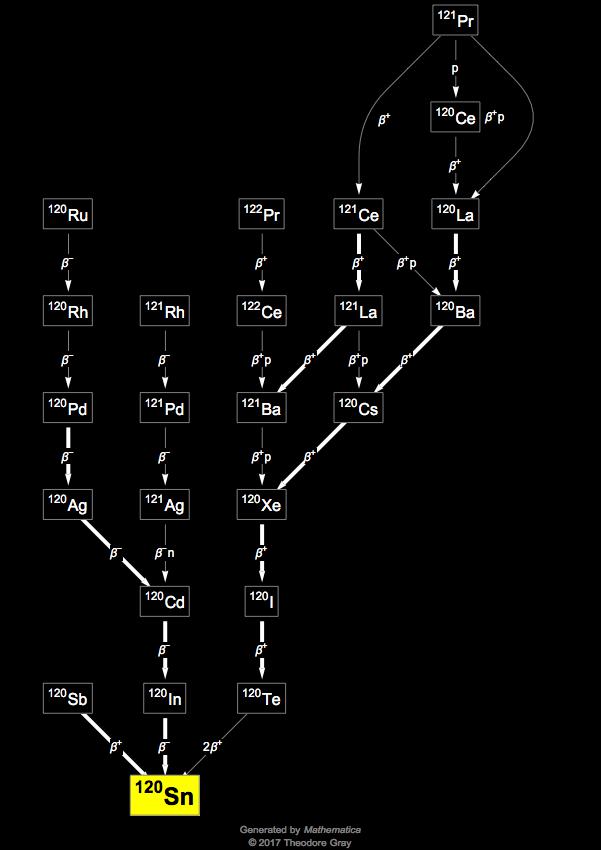
Tin (50Sn) is the element with the greatest number of stable isotopes (ten; three of them are potentially radioactive but have not been observed to decay). This is probably related to the fact that 50 is a "magic number" of protons. In addition, twenty-nine unstable tin isotopes are known, including tin-100 (100Sn) (discovered in 1994) and tin-132 (132Sn), which are both "doubly magic". The longest-lived tin radioisotope is tin-126 (126Sn), with a half-life of 230,000 years. The other 28 radioisotopes have half-lives of less than a year.
List of isotopes
Tin-117m
Tin-117m is a radioisotope of tin. One of its uses is in a particulate suspension to treat canine synovitis (radiosynoviorthesis).
Tin-121m
Tin-121m (121mSn) is a radioisotope and nuclear isomer of tin with a half-life of 43.9 years.
In a normal thermal reactor, it has a very low fission product yield; thus, this isotope is not a significant contributor to nuclear waste. Fast fission or fission of some heavier actinides will produce tin-121 at higher yields. For example, its yield from uranium-235 is 0.0007% per thermal fission and 0.002% per fast fission.
Tin-126
Tin-126 is a radioisotope of tin and one of the only seven long-lived fission products of uranium and plutonium. While tin-126's half-life of 230,000 years translates to a low specific activity of gamma radiation, its short-lived decay products, two isomers of antimony-126, emit 17 and 40 keV gamma radiation and a 3.67 MeV beta particle on their way to stable tellurium-126, making external exposure to tin-126 a potential concern.
Tin-126 is in the middle of the mass range for fission products. Thermal reactors, which make up almost all current nuclear power plants, produce it at a very low yield (0.056% for 235U), since slow neutrons almost always fission 235U or 239Pu into unequal halves. Fast fission in a fast reactor or nuclear weapon, or fission of some heavy minor actinides such as californium, will produce it at higher yields.
- ANL factsheet
References
- Isotope masses from:
- Audi, Georges; Bersillon, Olivier; Blachot, Jean; Wapstra, Aaldert Hendrik (2003), "The NUBASE evaluation of nuclear and decay properties", Nuclear Physics A, 729: 3–128, Bibcode:2003NuPhA.729....3A, doi:10.1016/j.nuclphysa.2003.11.001
- Isotopic compositions and standard atomic masses from:
- de Laeter, John Robert; Böhlke, John Karl; De Bièvre, Paul; Hidaka, Hiroshi; Peiser, H. Steffen; Rosman, Kevin J. R.; Taylor, Philip D. P. (2003). "Atomic weights of the elements. Review 2000 (IUPAC Technical Report)". Pure and Applied Chemistry. 75 (6): 683–800. doi:10.1351/pac200375060683.
- Wieser, Michael E. (2006). "Atomic weights of the elements 2005 (IUPAC Technical Report)". Pure and Applied Chemistry. 78 (11): 2051–2066. doi:10.1351/pac200678112051.
- "News & Notices: Standard Atomic Weights Revised". International Union of Pure and Applied Chemistry. 19 October 2005.
- Half-life, spin, and isomer data selected from:
- Audi, Georges; Bersillon, Olivier; Blachot, Jean; Wapstra, Aaldert Hendrik (2003), "The NUBASE evaluation of nuclear and decay properties", Nuclear Physics A, 729: 3–128, Bibcode:2003NuPhA.729....3A, doi:10.1016/j.nuclphysa.2003.11.001
- National Nuclear Data Center. "NuDat 2.x database". Brookhaven National Laboratory.
- Holden, Norman E. (2004). "11. Table of the Isotopes". In Lide, David R. (ed.). CRC Handbook of Chemistry and Physics (85th ed.). Boca Raton, Florida: CRC Press. ISBN 978-0-8493-0485-9.